
Introduction
Waterproofing directly influences structural life, safety, and lifecycle costs in India’s diverse conditions—from intense monsoons to coastal humidity and large temperature swings. Future Layers supplies specification-grade cementitious, PU, and polyurea systems engineered for Indian substrates, climates, and site realities, delivered with technical design support, certified applicators, and warranty-backed performance.
Cementitious waterproofing
Definition
Cementitious systems are cement-based coatings, often polymer-modified, that cure to a rigid or semi-flexible barrier compatible with concrete, masonry, and plaster.
Typical applications
- Basements, foundations, retaining walls
- Water tanks, STPs, swimming pools
- Bathrooms, lift pits, wet areas
- Internal negative/positive side works
Pros
- Easy brush/trowel application; tolerant to damp substrates
- Strong compatibility and bond with mineral substrates
- Cost-effective; good for hydrostatic pressure scenarios
- Breathable options reduce vapor entrapment risk
- Can be enhanced with crystalline or integral additives
Cons
- Limited crack-bridging and flexibility
- Needs protective screed or tile in exposed/traffic areas
- Lower UV and chemical resistance
- Quality depends on surface prep, mixing, curing
Polyurethane (PU) waterproofing
Definition
PU systems are liquid-applied elastomeric membranes that cure to a seamless, flexible film with excellent adhesion on concrete, metal, wood, and ceramic surfaces.
Typical applications
- Roofs, terraces, balconies, podiums
- Wet areas under tile (bathrooms, kitchens)
- Lightweight roofs, parapets, complex details
- Recoating of aged membranes with proper priming
Pros
- High elasticity and crack-bridging for thermal/movement cycles
- Seamless finish reduces joint-related leaks
- Good UV/weathering resistance for exposed use
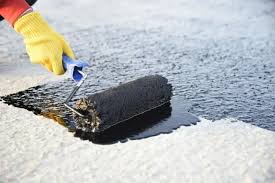
- Straightforward liquid application by brush/roller/spray
- Recoatable; relatively low maintenance
Cons
- Higher material cost than cementitious systems
- Moisture-sensitive during application; primers often mandatory
- Requires skilled applicators to avoid bubbles, pinholes, and poor cure
- Some grades have VOCs; ventilation required during install
Polyurea waterproofing
Definition
Polyurea is a two-component, spray-applied elastomer that cures within seconds, forming a seamless, highly durable membrane suitable for heavy-duty and time-critical works.
Typical applications
- Podium decks, car parks, ramps, industrial floors
- Bridges, tunnels, infrastructure, podium landscapes
- Roofs needing rapid return-to-service
- Tanks, containment, wastewater zones
Pros
- Ultra-fast cure enables rapid project turnover
- Exceptional mechanical strength and abrasion resistance
- Superior chemical and UV durability
- High elongation and crack-bridging capacity
- 100% solids variants with very low VOC
- Applied in high-build, seamless layers
Cons
- Specialized spray equipment and certified crews required
- Stringent substrate prep and environmental controls
- Highest upfront cost (often offset by lifecycle savings)
- Less practical for small residential areas
Comparison table
| Feature | Cementitious | PU (Polyurethane) | Polyurea |
| Flexibility/Crack-bridging | Low to moderate | High | Very high |
| Seamlessness | Joints between coats possible | Seamless liquid membrane | Seamless spray membrane |
| Curing time | 24–72 hours | 8–24 hours | Seconds to minutes |
| UV/Chemical resistance | Low to moderate | High (with UV-stable grades) | Very high |
| Typical lifespan | 5–10 years | 8–12 years | 15–25+ years |
| Application method | Brush/trowel | Brush/roller/spray | Two-component spray |
| Typical uses | Tanks, basements, wet areas | Roofs, terraces, wet areas | Podiums, decks, infrastructure |
| Maintenance | Moderate | Low | Very low |
| Typical Indian cost range | Low | Medium | High |
| Crew/equipment need | Basic | Skilled, primers/tools | Highly specialized |
Selection guidance for Indian conditions
- High hydrostatic pressure (basements, pits): Cementitious, crystalline-enhanced where needed.
- Exposed terraces/roofs with thermal cycling: PU for cost-performance; polyurea for fastest turnaround and maximum durability.
- Heavy-traffic podiums/parking: Polyurea for abrasion, impact, and quick re-opening.
- Potable water tanks/wet interiors: Cementitious or PU grades approved for water contact.
- Aggressive chemical/industrial: Polyurea; consider appropriate topcoats for specific chemicals.
Stepwise application methodology
Surface preparation
- Remove laitance, dust, oils; repair cracks/honeycombs; ensure falls toward drains.
- Moisture criteria: Cementitious can tolerate damp; PU/polyurea typically require dry, primed substrates.
- Profile: Achieve sound, profiled surface (e.g., CSP 2–4 equivalents).
Priming
- Cementitious: Dampen substrate; use bond coat if specified.
- PU: Use compatible primers for dense/porous/previously coated substrates; moisture-tolerant primers where applicable.
- Polyurea: Moisture-tolerant epoxies or polyurea-specific primers; check recoat windows.
Application and thickness
- Cementitious: 2–3 coats, typical DFT 1–2 mm; embed mesh at joints/corners.
- PU: 2–3 coats to system DFT (often 1.2–2.0 mm); reinforce details.
- Polyurea: Spray to specified thickness (1.5–3.0+ mm) in passes; seamless continuity at details.
Curing and QA/QC
- Respect recoat and cure times; control humidity, temperature, dew point.
- Wet film gauges/DFT checks; adhesion tests, holiday/spark testing for thick membranes.
- Water ponding tests where applicable before finishes.
Protection and finishes
- Cementitious: Protective screed or tile in exposed/traffic areas.
- PU: UV-stable topcoat where required; anti-slip aggregate for traffic.
- Polyurea: Trafficable topcoats/markings; optional UV/colour coats.
Common failure modes and prevention
- Debonding/blistering from trapped moisture or lack of primer: Verify substrate dryness and correct primer selection.
- Pinholing from outgassing: Apply during falling temperatures; use primers and staged coats.
- Cracking telegraphing: Choose elastic systems (PU/polyurea) and treat dynamic joints with sealants/bandages.
- Inadequate thickness: Measure WFT/DFT rigorously and document.
Compliance and QA
- Specify systems aligned to relevant IS/ASTM/EN test criteria for elongation, adhesion, water pressure resistance, chemical resistance, and UV stability.
- Use certified applicators; maintain batch records, WFT/DFT logs, adhesion test results, and photographic QA dossiers for warranties.
- Ensure safety and environmental controls for VOCs, ventilation, and hot work where applicable.
Cost and lifecycle considerations in India
- Cementitious: Lowest initial cost; periodic inspection and protection layers add to lifecycle cost.
- PU: Medium initial cost with reduced maintenance; good balance for exposed terraces/roofs.
- Polyurea: Highest initial cost; minimal downtime and long service life reduce total cost of ownership on critical assets.
FAQs
- Which is best for monsoon-exposed terraces?
PU offers strong performance at moderate cost; polyurea is preferred where rapid turnaround and maximum durability are required. - What works best for basements with hydrostatic pressure?
Cementitious (including crystalline-modified) systems are well-suited, with attention to surface prep and detailing. - Can these systems go under tiles?
Yes. Cementitious and PU are commonly used under tile beds; ensure correct primers and bond coats. - What about potable water tanks?
Use approved cementitious or PU grades designed for potable water contact. - How to handle expansion joints?
Use compatible elastomeric sealants and bandages; do not bridge active joints with rigid coatings. - Are these systems UV-stable?
Cementitious is limited in UV; PU and polyurea are available in UV-stable formulations or with protective topcoats. - Expected service life?
Broadly: cementitious 5–10 years, PU 8–12 years, polyurea 15–25+ years, subject to design, environment, and QA. - Can PU/polyurea be applied on damp surfaces?
Generally no; substrates should be dry and primed unless using specialized moisture-tolerant primers. - Is polyurea overkill for residences?
Often yes for small areas; it excels in large, time-critical, or heavy-duty applications. - How to decide finally?
Match movement, exposure, load, downtime, and budget. Request a site evaluation and specification from Future Layers.
- Request a site survey and system specification tailored to climate, substrate, and use.
- Ask for a warranty-backed proposal with certified installation.
- Order cementitious, PU, or polyurea systems from Future Layers and schedule an expert consultation.